Buildings in Kukkolaforsen
In Swedish Kukkola, the rapids area is located in the lower part of the village, where the power of the Torne River has, over centuries, shaped both the landscape and the ways people live and work. Next to the rapids lies a continuous area of culturally and historically valuable buildings, known as the cultural village. The area is divided into a northern and a southern part, each reflecting different functions connected to the river and its resources.
Southern cultural village – the center of dipnet fishing
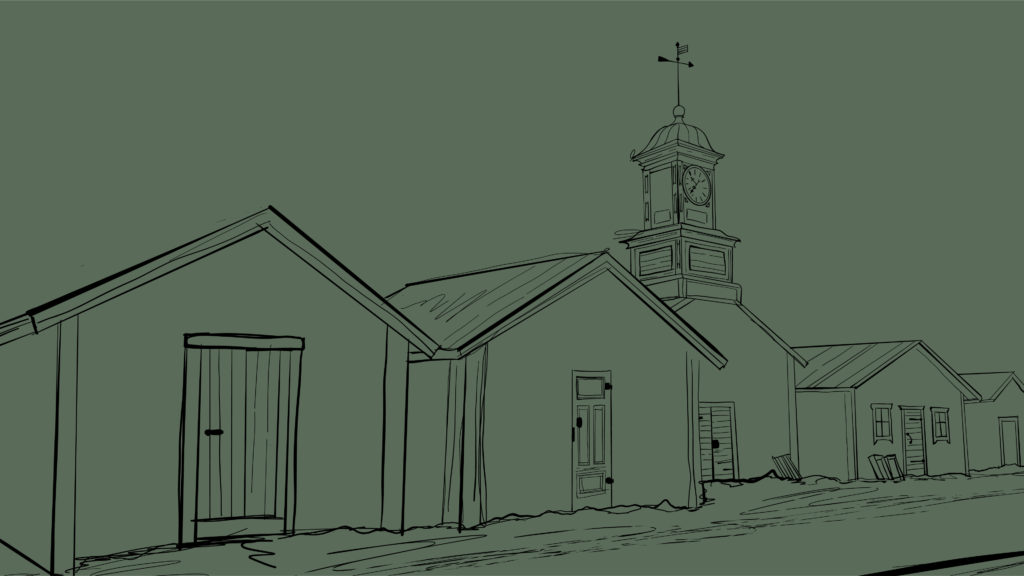
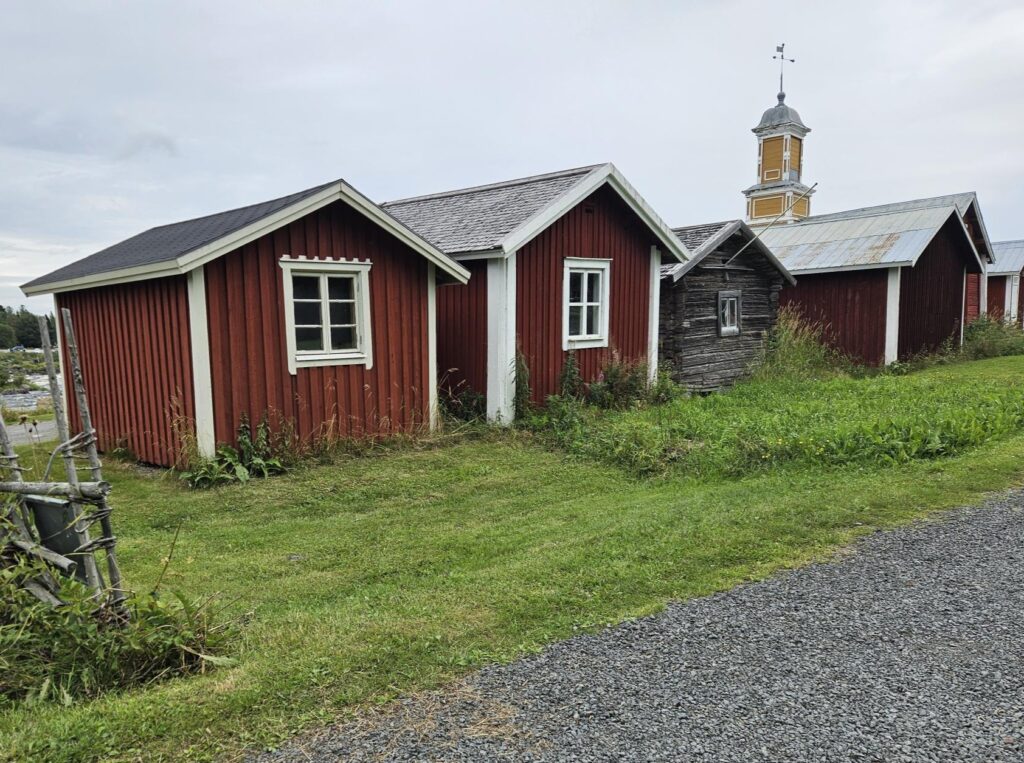
The southern part of the cultural village consists of the rapid area and is strongly characterized by dipnet fishing tradition. The most prominent buildings here are the division hut with its bell tower and the grilling hut (stekkota). The division hut and the bell tower have played a central role in coordination and collective decision-making, with the bell signaling times and order in fishing. Adjacent to these buildings are the office, the ice cellar, and five smaller fishing huts.
The fishing huts, located close to the river, have been used for equipment, storage, and work during the fishing season and are closely connected to everyday life at the rapids.
Northern cultural village – mills and craftsmanship
In the northern part of the cultural village, the two mills are the main buildings. Here, the power of the rapids was used to grind grain. Near the mills are several other buildings that show how activities were organized: a miller’s cottage, a storage loft (aitta), a sawmill building, a timber storage building, and a smithy.
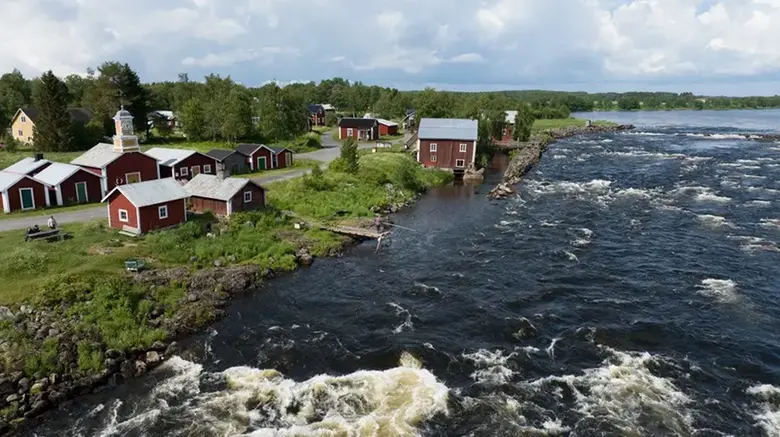
Photo: City of Haparanda
Division hut (Delningboden)
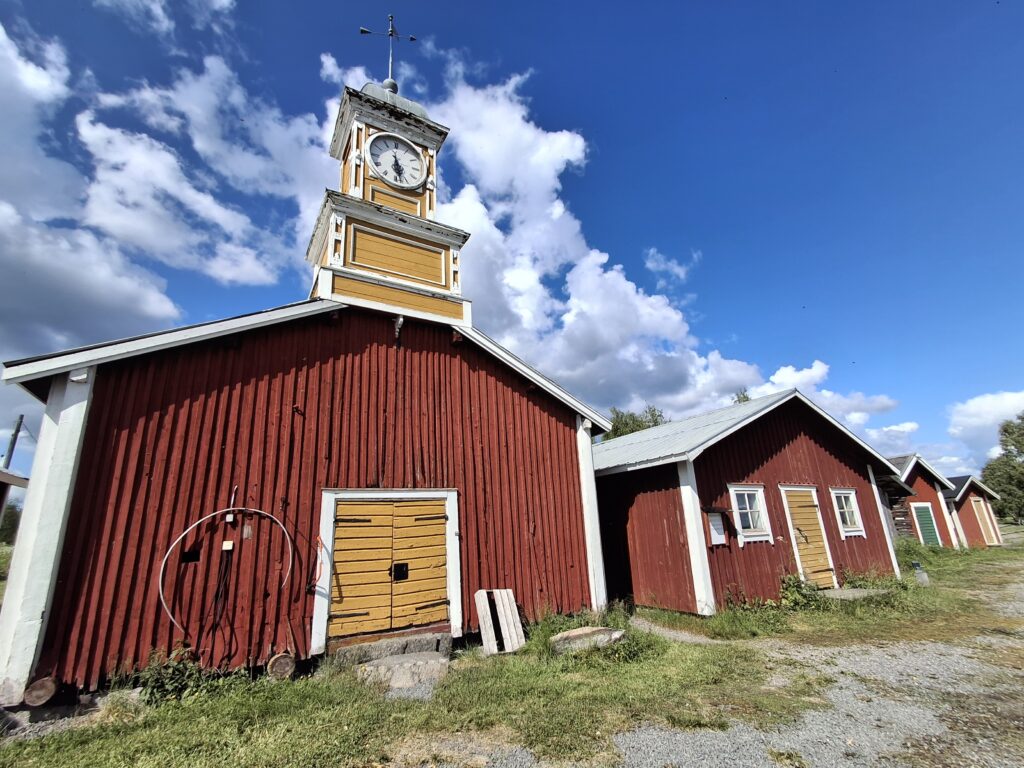
The division hut, also known as the bell house, is possibly the most impressive and significant building in Kukkola and one of the most culturally and historically valuable. It was built in 1889 after its predecessor burned down in 1886. The building was used as a storage place for the village’s shared fishing equipment and as an early administrative office. Inside, there is a built-in locked storage compartment, suggesting that the building also played a role in administration, serving as a place to store important documents and possibly money. The bell in the tower was made by clockmaker Salomon Ajo from Övertorneå and helped fishers keep track of important work shift times.
Ice cellar
Next to the division hut is the so-called ice cellar, used to store the fish catch. Its walls are about one meter thick, insulating the cold storage space. Whitefish is still stored there in wooden boxes. The current ice cellar was built in the mid-1990s.
Grilling hut (Halstringskåta)
The grilling hut is a rectangular building that was originally used to accommodate visiting fishers. Inside, benches run along the walls where fishers slept, while the central hearth provided both heat and a place for cooking. Today, the hut is used as a break shelter during fishing and for gatherings where whitefish is grilled.
The hut may have been built in 1874—the year is carved into a log on the inside of the southern wall. This type of building may have existed at the rapids already in the 18th century. The construction resembles old traditional cottages where smoke from the hearth, in the absence of a chimney, was vented through an opening in the roof. This smoke outlet, known as a räppänä, consisted of a timber smoke channel rising above the roof ridge. The interior had an earthen floor and a centrally placed open, raised hearth. Smaller whitefish were grilled on wooden skewers placed near the fire, while whitefish soup was cooked in a kettle hung above it.
Fishing huts
There are five fishing huts located in the inner row of buildings, on the western side of the pathway running through the area. They were used to store fishing gear, while overnight stays took place in the grilling hut. Some of the huts were previously located near the grilling hut but were moved to their current locations in the early 1970s.
Mills
The area includes two water-powered mills: the lower mill, built around 1840, and the upper mill, built in the 1850s.
The lower mill was a waterwheel-driven toll mill, meaning that those who had their grain milled paid a fee—often in grain to the state—and the miller also received compensation. Farmers from both Sweden and Finland came to Kukkolaforsen to grind their grain. In 1939, the old millstone system was replaced with a roller mill, which can still be seen today.
The upper mill was also water-driven and functioned as a toll mill. With the installation of three turbines, it could power several activities simultaneously—sawmilling, grain milling, and later electricity production. During low water levels, the turbines could be connected to provide enough power for at least one function.
By the mid-20th century, milling activity declined as electric mills became more common in the Torne Valley. Grain milling largely ceased in the 1950s, after which sawmill operations became more important.
Vahanpirtti
Next to the mills stands Vahanpirtti, a log-built miller’s cottage constructed in the 1880s as the residence of the miller at the upper mill. The miller Johan Petter and Maria Johanna Lahti lived there with their family during the active period of milling, and the building remained in residential use well into the 20th century.
Vahanpirtti is closely tied to the mill and sawmill operations and provides a tangible picture of everyday life around the rapids. In the 1970s, the building was slightly relocated within the area to its current position. Together with the mills and other buildings, it helps illustrate Kukkolaforsen as a unified cultural environment where work, living, and water power were closely interconnected.
The sawmill
The sawmill building at Kukkolaforsen is part of the mill area in the northern cultural village and has been closely linked to the upper mill. The current building was constructed in 1903 and, like the mills, utilized the power of the rapids. It was used to process timber that was floated or transported to the site and served local needs.
The sawmill was technically and functionally connected to the mill. Multiple turbines installed in the upper mill enabled the operation of the mill, sawmill, and later electricity production, depending on water conditions. During the 20th century, the importance of the sawmill increased as milling declined.
Fishing Museum
The Fishing Museum at Kukkolaforsen is housed in a building originally constructed as a salmon breeding facility in the early 1980s. It was completed in 1982 as part of efforts to support fisheries management in the Torne River.
In the mid-1980s, the fishing museum moved into the upper floor of the building, giving it a new role as a place for presenting the history, traditions, and knowledge of dipnet fishing.

Whitefish dipnet statue
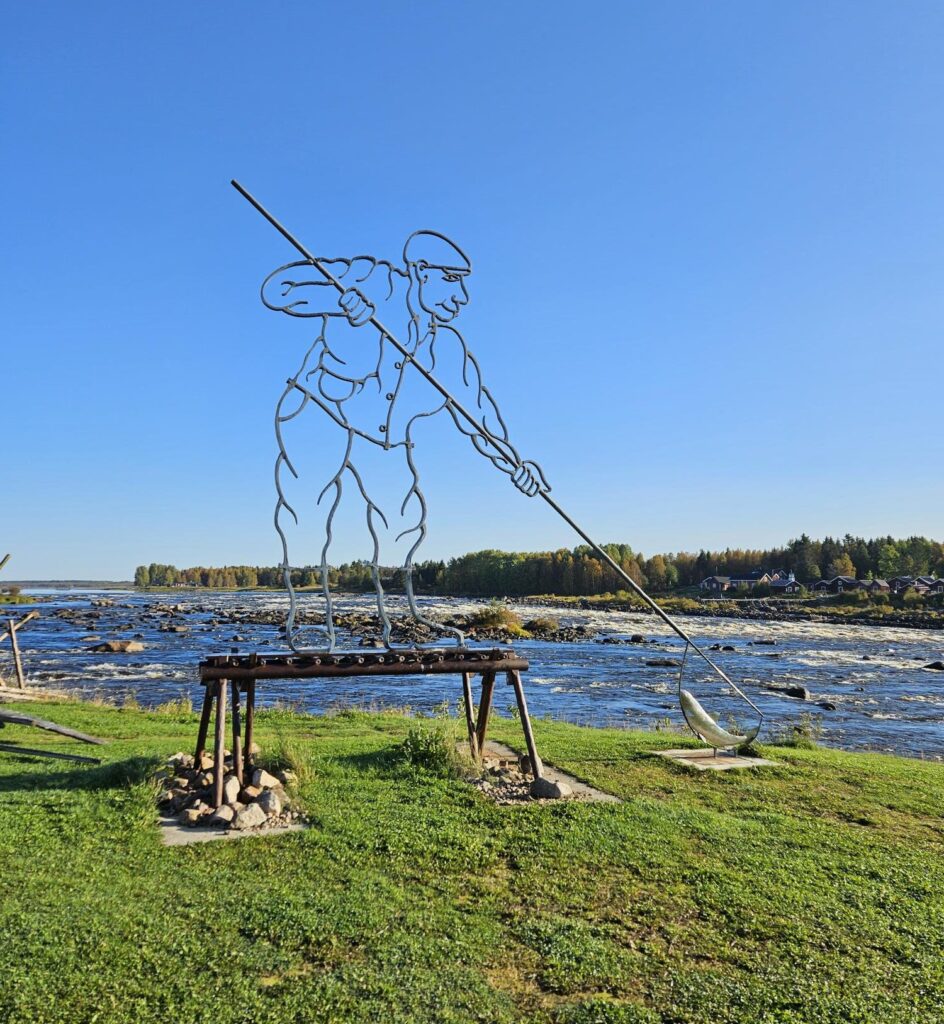
The Whitefish Dipnet Statue at Kukkolaforsen was created by sculptor Erik Vargtand based on a citizen proposal by Eva Pesula. The statue pays tribute to whitefish dipnet fishing and its cultural-historical significance in the Torne River.
The approximately five-meter-high silhouette statue, unveiled in 2016, weighs around 1,200 kilograms. Its semi-transparent design integrates with the surroundings, connecting the flowing water of the rapids with the sky above. The statue serves both as an artistic landmark and as a symbol of the living dipnet fishing tradition at Kukkolaforsen.